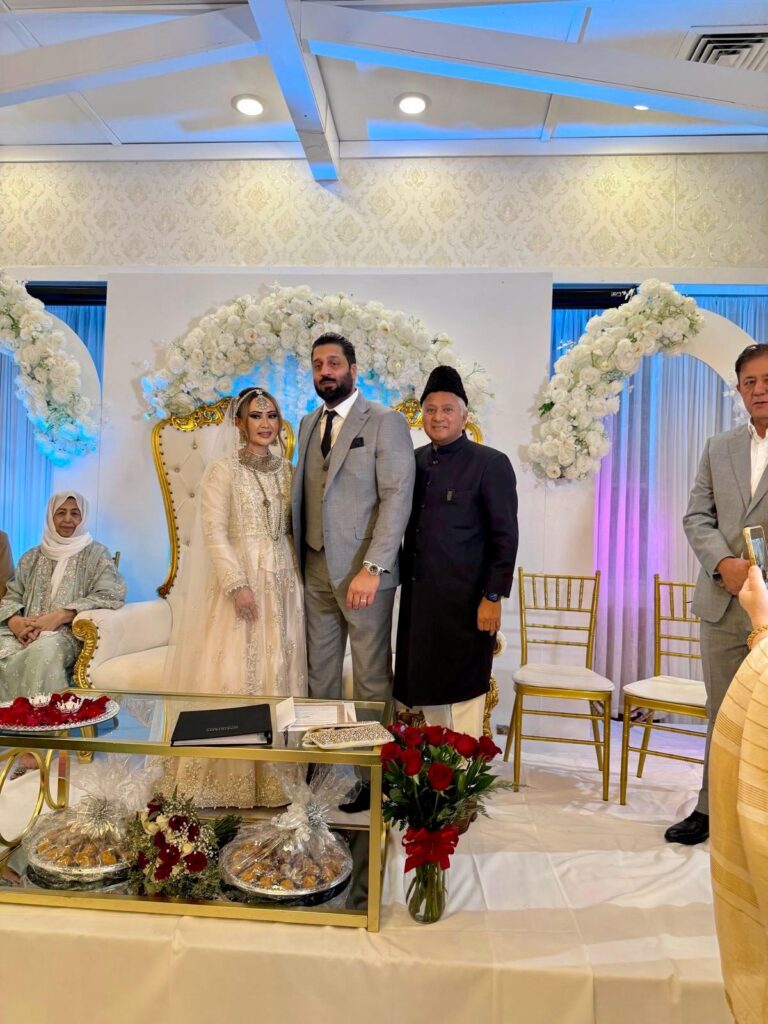
Introduction to the Muslim Nikah Ceremony
This wedding beautifully united a Pakistani Muslim groom and an Afghan Muslim bride. The groom requested that a portion of the ceremony be delivered in Urdu—a request I was honored to fulfill, as Urdu is my mother tongue. While the ceremony was primarily conducted in English, it included Arabic verses and their translations. We intentionally structured the Muslim Nikah Ceremony in clear, educational steps so that children and guests could easily understand the meaning and process behind a Nikah.
Common Misunderstandings About the Nikah
Many Muslims and non-Muslims believe the Nikah consists only of the repeated declaration “Qabool, Qabool, Qabool.” Though this acceptance is essential, the Nikah is far more detailed. It includes:
- Free will of both spouses
- Optional family blessings
- The Mahr (marital gift)
- Ijab o Qabool (Mutual Acceptance)
- Signatures of the bride, groom, guardian/wakil, witnesses, and officiant
- The Qutba (Sermon)
- Duwa (Prayers)
- Public announcement
- Walima (Celebratory dinner)
Cultural Traditions: The Flower Screen Ceremony
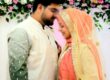
A revived cultural tradition in several South Asian and Afghan marriages is the use of a flower screen separating the bride and groom at the start.
How the Flower Screen Works
- The groom enters with his parents and sits on one side.
- The bride enters with her parents and sits on the other side.
- The couple responds to the formal question,
“Do you take this person as your spouse according to Muslim religious traditions?”
by saying “Qabool” three times. - After acceptance, the groom walks through the floral screen to embrace his bride.
To add warmth and personality, the groom is often invited to sing a line or two from his favorite romantic song as he steps through the screen.
Incorporating Civic Traditions
Depending on the couple’s preferences, we also blend in various civic wedding elements, including:
- Bridesmaids
- Groomsmen
- Flower girls
- Ring bearer
- Exchange of rings
- Optional Muslim Vows
Every wedding is uniquely tailored—some elaborate, some simple—always based on the couple’s wishes. We also speak with parents to ensure harmony and support from all sides.
A Record of Diverse Nikah Ceremonies
Of the 589 interfaith weddings I’ve officiated, this was my 61st Nikah ceremony between two Muslims, spanning nearly all major Muslim denominations (madhabs).
Twenty-four years ago, I wrote a statement for the World Muslim Congress—a think tank dedicated to fostering respect and acceptance among Muslims with diverse beliefs. That statement continues to guide my work today.
A Muslim Is a Muslim Is a Muslim
“At the World Muslim Congress, we make no distinction between one Muslim and another. If you believe in God, are accountable for your actions, treat others as equals, and act justly, mercifully, and kindly toward all of creation, you are a Muslim. If we were to define God’s will, it is simply to preserve and maintain harmony within His creation.” Who is a Muslim and what is Islam? https://interfaithmarriages.org/who-is-a-muslim-and-what-is-islam/
Serving the Muslim Community With Unity
I thank God for allowing me to be an instrument of cohesion within the Aalameen (Universe) and for helping me live up to the message I shared more than two decades ago. I am honored to have officiated Nikah ceremonies for Muslims from many backgrounds, including:
- Shia
- Sunni
- Bohra
- Ismaili
- Ahmadi
- Sufi
- Nation of Islam
There are more, but these represent the major denominations, each with its own unique subgroups.
About the Officiant
Dr. Ghouse is the President and founder of the Center for Pluralism and director of the World Muslim Congress. He is an Interfaith Wedding Officiant for InterfaithMarriages.org and a Muslim Wedding Officiant. He is a Muslim, Pluralist, activist, speaker, author, and social scientist. More on Google