
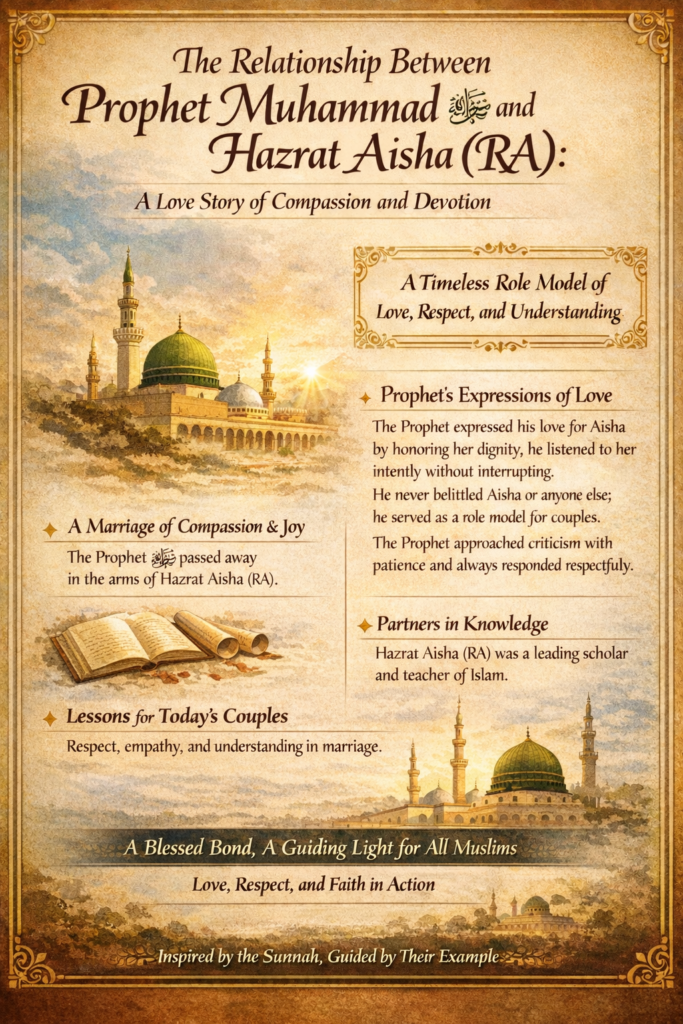
The relationship between Prophet Muhammad ﷺ and Hazrat Aisha (RA) stands as one of the most beautiful and meaningful examples of marital harmony in Islamic history. Rooted in compassion, mutual respect, equality, emotional intimacy, and spiritual partnership, their marriage reflects the true essence of Islam’s teachings on love and companionship. Far from being distant or rigid, their bond was warm, affectionate, and deeply human—offering Muslims across generations a practical role model for healthy relationships.
Islam places great emphasis on kindness within marriage, and the Prophet Muhammad ﷺ embodied this principle in his relationship with Hazrat Aisha. He expressed love openly, shared moments of joy, and offered unwavering support during times of difficulty. Their relationship was not limited to formal obligations; rather, it was enriched by companionship, humor, emotional understanding, and sincere care.
One of the most touching testimonies of their bond is found in the Prophet’s final moments. During his last illness, Prophet Muhammad ﷺ chose to spend his final days in the home of Hazrat Aisha. As narrated in Sahih al-Bukhari (1389), he rested his blessed head on her chest and breathed his last while in her arms. This deeply emotional moment reflects the profound trust, comfort, and love that existed between them. Even at the threshold of death, the Prophet ﷺ sought closeness to Hazrat Aisha, highlighting the emotional depth of their relationship.
This moment is not merely historical—it is instructional. It teaches Muslims that emotional closeness, tenderness, and vulnerability within marriage are not weaknesses but strengths. The relationship between Prophet Muhammad ﷺ and Hazrat Aisha (RA) demonstrates that love in Islam is compassionate, reassuring, and deeply respectful.
Hazrat Aisha (RA), also known as Ummul Momineen (Mother of the Believers), often shared personal insights into her life with the Prophet ﷺ. She described how they would sit together, talk, laugh, and share meals. The Prophet ﷺ would drink from the same cup she used, placing his lips where hers had been, and they would feed one another—simple yet powerful gestures that reveal genuine affection and emotional intimacy. These actions show that Islam encourages closeness and warmth between spouses.
Beyond affection, their relationship was also an intellectual and spiritual partnership. Hazrat Aisha was known for her sharp intellect, curiosity, and deep understanding of Islam. The Prophet ﷺ nurtured her knowledge and never dismissed her questions or opinions. After his passing, Hazrat Aisha became one of the most influential scholars in Islamic history, narrating over 2,000 hadiths. She was a leading authority on Islamic law (fiqh), theology, and even medicine, and many senior companions sought her guidance.
This aspect of their marriage teaches Muslims that a strong relationship is built not only on love but also on respect for each other’s intellect and abilities. The relationship between Prophet Muhammad ﷺ and Hazrat Aisha (RA) shows that empowering one’s spouse and valuing their growth is a core Islamic principle.
Importantly, their relationship also endured challenges, misunderstandings, and moments of emotional strain—just like any real marriage. Yet, the Prophet ﷺ handled these situations with patience, wisdom, and fairness. He listened, reassured, and resolved conflicts with love and kindness. This balanced approach provides Muslims with a realistic and achievable model for harmonious marital life.
In today’s world, where relationships are often strained by unrealistic expectations or lack of communication, the example of Prophet Muhammad ﷺ and Hazrat Aisha (RA) offers timeless guidance. Their marriage teaches us that love must be nurtured through kindness, respect, emotional availability, and faith.
Conclusion
The relationship between Prophet Muhammad ﷺ and Hazrat Aisha (RA) is not just a historical narrative—it is a living model for Muslims seeking meaningful, loving, and faith-centered relationships. Their bond reminds us that Islam honors love, values emotional connection, and encourages mutual respect between spouses. By reflecting on their example, Muslims can learn how to build relationships grounded in compassion, understanding, and devotion to Allah.
Dr. Ghouse is the President and founder of the Center for Pluralism and director of the World Muslim Congress. He is an Interfaith Wedding Officiant for InterfaithMarriages.org and a Muslim Wedding Officiant. He is a Muslim, Pluralist, activist, speaker, author, and social scientist. More on Google