
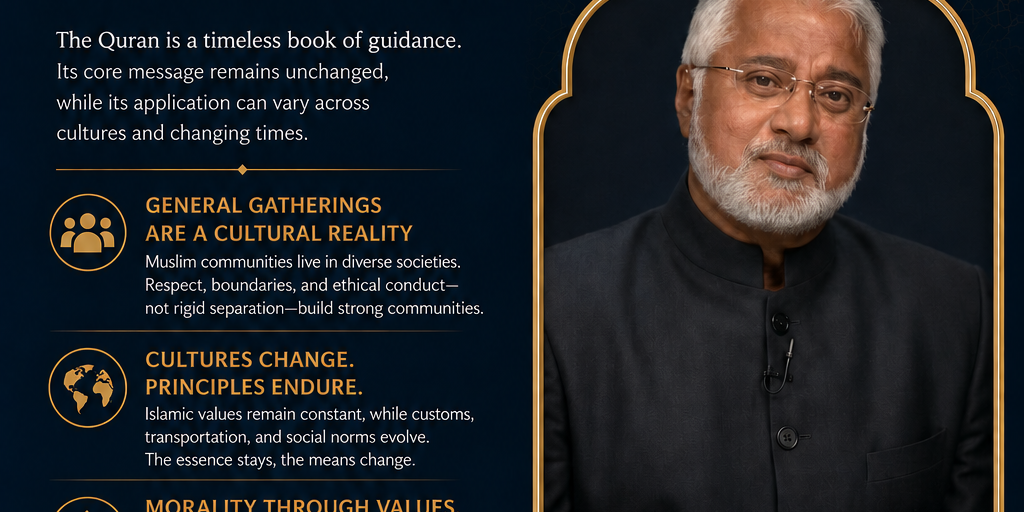
Is the Quran Timeless?
I was recently asked about the acceptability of mixed-gender gatherings in Muslim marriages. I responded that the Quran serves as a timeless book of guidance. While the core guidance remains unchanged, its application can vary across different cultures. Islam is a pluralistic tradition, and we respect how people live their lives.
Executive Summary
In a rapidly changing world, the Quran remains timeless by preserving eternal values while allowing cultures and societies to evolve naturally. This thought-provoking article explores how Islam balances faith, modernity, and cultural adaptation through topics like mixed-gender gatherings, progressive Muslim perspectives, and social transformation. Drawing on the Prophet Muhammad’s reformative vision, it highlights the difference between unchanging spiritual principles and changing human lifestyles. Ultimately, the article presents Islam as a faith rooted in reflection, compassion, justice, and relevance across every generation.
Mixed-Gender Gatherings in Muslim Marriages and the Timeless Quran
The question mentioned above typically doesn’t arise among progressive or moderate Muslims, who make up more than two-thirds of the Muslim population. The irony lies in the fact that a Saudi Muslim woman married a Catholic in Boston, while an Iranian woman married a Christian in Dallas. They wanted me to address this issue as a cultural question.
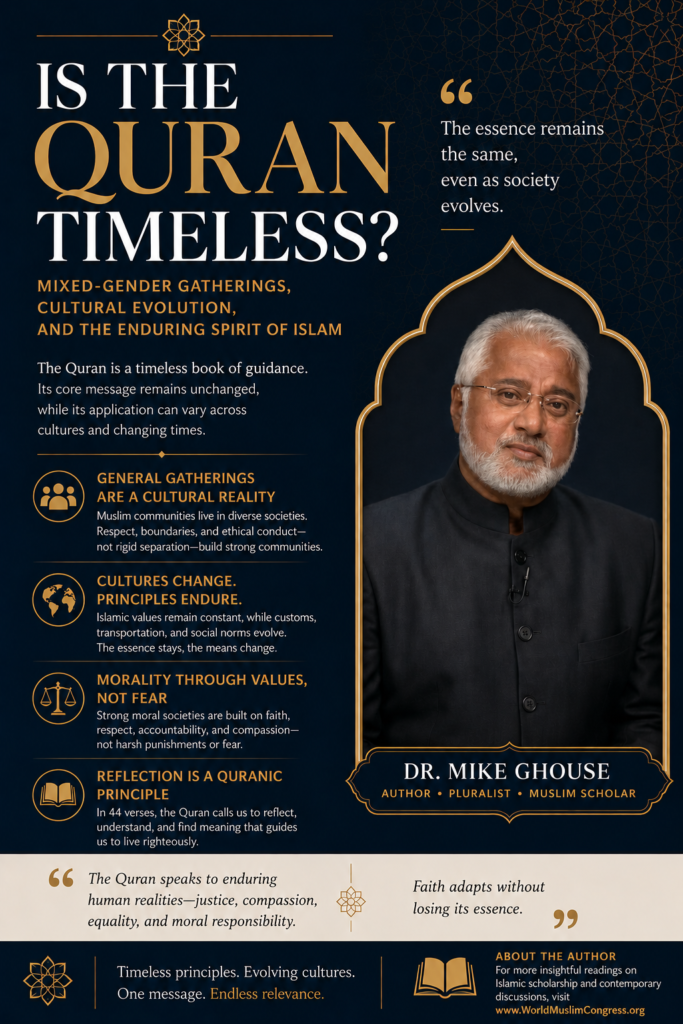
A progressive Muslim is someone who understands the essence of a verse from the Quran rather than taking it literally — the example of Hajj is given below.
This opening itself reflects a much broader conversation taking place within modern Muslim communities: how timeless religious values interact with rapidly evolving cultural realities.
Understanding “Ikhtilat” in Islamic Discussions
This discussion concerns situations in which men and women come together in social or professional settings, such as weddings, without clear boundaries, segregation, or supervision.
The term “Ikhtilat” refers to the interaction or mingling between non-related men and women — those who are na-mahram, meaning they could legally marry one another. In contrast, a mahram is a family member with whom marriage is permanently prohibited.
Historically, this principle has been applied more strictly, and many conservative Muslim societies still practice some form of separation.
However, in American culture, diverse individuals — regardless of faith, race, or gender — often coexist, work together, share meals, and celebrate events like July 4th together. Mixed-gender spaces at occasions such as weddings are the norm and should be embraced as part of our shared experiences.
This contrast between traditional social structures and contemporary multicultural environments continues to shape discussions among Muslims living in different parts of the world.
Cultural Values and Social Norms Across Muslim Societies
Cultural values also play an important role in shaping how Muslim communities approach mixed-gender gatherings. In some cultures, social interaction between men and women in family settings, weddings, educational institutions, or professional environments is considered a normal part of community life. In other cultures, greater separation is preferred as a reflection of local customs and traditions.
These differences often arise from historical, regional, and societal influences rather than from a single universal cultural model within Islam itself. As Muslim communities continue to grow across diverse parts of the world, many families navigate these questions by balancing religious principles with the cultural realities of the societies in which they live.
This diversity reflects the broader adaptability of Islamic civilization across generations, languages, and cultures while still maintaining a shared spiritual foundation.
Fear, Morality, and the Reality of Modern Society
While there is a lingering fear of zina (illegal sexual relations), our societies tend to be safe. Most Muslim men and women commonly practice the principle of “no sex until marriage.”
I have interviewed nearly 700 couples, and their relationships generally remained stable and often culminated in marriage.
This observation challenges the assumption that every mixed-gender interaction inevitably leads to moral decline. In many cases, communities establish ethical boundaries through personal values, mutual respect, and social responsibility rather than rigid physical separation alone.
Cultural responses to wrongdoing do exist, but they don’t involve severe punishments like beheading or hand severing. Legal systems and societies now handle consequences differently.
For instance, in cases of rape, DNA testing provides evidence without the need for three male witnesses.
This reflects how legal frameworks and methods of accountability evolve alongside advancements in science, technology, and human understanding.
Islam as a Progressive Force in Human History
We have made considerable progress, but there is still much more to do.
Islam is a progressive religion; the Prophet Muhammad transformed society over his 23-year mission. He emphasized that no man is superior to another and laid the foundation for gender equality by affirmatively stating that women can own businesses and have the autonomy to marry or divorce as they choose.
He stressed that all humans are equal, a principle also enshrined in the Declaration of Independence: that all men are created equal.
These teachings were revolutionary for their time and continue to inspire conversations around justice, dignity, equality, and human rights today.
The Prophet’s mission was not limited to rituals or theology alone. It was also about transforming society through compassion, moral reform, and social responsibility.
Is the Quran Timeless? Understanding the Essence Beyond Literalism
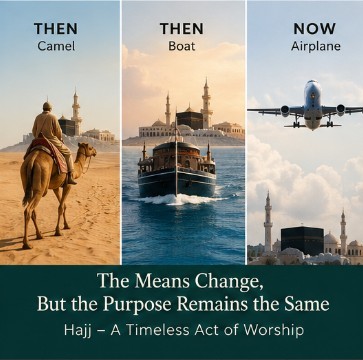
The Quran is timeless, addressing the essence of human experience across the ages.
In contemporary culture, it is common for families and friends to gather, regardless of gender, to enjoy each other’s company.
To illustrate the Quran’s timelessness, consider when Prophet Muhammad spoke to his followers in Medina, saying:
“You can go to Hajj if you can afford it.”
During that time, people thought about which camel to ride to Mecca. A millennium later, people in Indonesia, India, and Tanzania considered which boat to take to Jeddah.
Today, we face different choices, such as which airline to use.
The essence of performing Hajj remains the same, but the means of transport evolve.
This example powerfully demonstrates the distinction between eternal principles and changing methods. The spiritual obligation remains intact even though human lifestyles, transportation, and societies continue to evolve.
That is precisely why many believers continue asking the profound question: Is the Quran timeless?
Cultural Adaptation vs. Religious Obligation
Though the Quran’s message is unchanged, our cultural adaptations have evolved.
The guidance of the Prophet and the Quran is meant to convey deeper meanings, not always to be taken literally.
While we may not eat as the Prophet did or wear his clothing, we adapt our practices according to cultural norms. These are cultural choices rather than religious obligations.
This distinction is crucial.
In many discussions surrounding Islam, culture and religion often become intertwined to the point where historical customs are mistaken for eternal commandments. Yet Islamic thought has long recognized the importance of understanding context, intention, and practicality.
The timelessness of Islam lies not in freezing humanity in one historical era, but in preserving universal moral principles while allowing societies to grow naturally over time.
The Quran’s Call to Reflection and Understanding
In 44 verses, the Quran encourages readers to reflect on each verse, its intent, and whether it resonates with them.
It’s important to keep exploring until you find a perspective that feels right.
Ultimately, the goal of this guidance is to create cohesive societies where every individual feels secure.
This repeated emphasis on reflection reveals that Islam encourages thoughtful engagement rather than blind imitation. The Quran consistently calls upon believers to think, reason, observe, and seek wisdom.
Such reflection allows faith to remain meaningful across generations and cultures.
Faith, Society, and the Evolving Human Experience
Religion serves as a personal guide, enabling individuals to live righteous lives while adapting to their surroundings.
Embracing cultural shifts does not diminish faith; rather, it enriches our understanding and practice of it.
As societies evolve, technology advances, and cultures interact more closely than ever before, believers continue searching for ways to preserve spiritual values while participating fully in modern life.
The Quran’s enduring relevance comes from its focus on timeless human concerns — morality, justice, compassion, dignity, equality, and purpose.
For many Muslims around the world, this balance between eternal guidance and cultural adaptation is exactly what makes the Quran timeless.
Conclusion: The Timeless Message of the Quran in a Changing World
The question “Is the Quran timeless?” continues to resonate because humanity itself continues to evolve.
Cultures change. Transportation changes. Social norms change. Yet the deeper human search for meaning, belonging, morality, and spiritual peace remains constant.
The Quran speaks to those enduring realities.
Its principles continue to inspire reflection, justice, compassion, equality, and moral responsibility across generations. While methods and cultural expressions may evolve, the essence of the message remains remarkably relevant.
That enduring balance between eternal truth and human adaptability is what many believers see as the true timelessness of the Quran.
For additional reading on Islamic scholarship and contemporary discussions, visit Yaqeen Institute.
Progressive Islam: Reviving the Prophet’s Vision in Today’s World
https://worldmuslimcongress.org/progressive-islam-reviving-the-prophets-vision-in-todays-world/
Who is a Muslim and what is Islam?
https://interfaithmarriages.org/who-is-a-muslim-and-what-is-islam/
Why did I come to Washington, and why am I returning to Dallas?
https://centerforpluralism.com/why-i-came-to-washington-why-i-am-returning-to-dallas/
2) A Lamp That Connects Hearts — A Radiant Journey of Love, Thought, and Service
3) Background of Dr. Mike Mohamed Ghouse (multiple links)
Dr. Ghouse is the President and founder of the Center for Pluralism and director of the World Muslim Congress. He is an Interfaith Wedding Officiant for InterfaithMarriages.org and a supporter of Muslims for Progressive Values. He is a Muslim, Pluralist, activist, speaker, author, and social scientist. More on Google.