
Wondering if a Western-style Muslim wedding is allowed in Islam? A Muslim wedding officiant explains how couples can combine a Western-style wedding with an Islamic nikah while staying faithful to Islamic marriage rules.
I often receive thoughtful questions from couples who are trying to honor both their Islamic values and their cultural backgrounds. One question that comes up frequently is whether it is possible to have a Western-style wedding ceremony while still keeping the marriage fully Islamically valid.
Recently, a young Muslim woman wrote to me explaining that she plans to marry a man who intends to embrace Islam. He comes from a very American background, and as they began discussing their wedding, he wondered if they could include some familiar traditions—such as walking down the aisle, saying “I do,” or exchanging vows.
Her concern was heartfelt: Can we incorporate some of these traditions while still keeping the marriage Islamically sound?
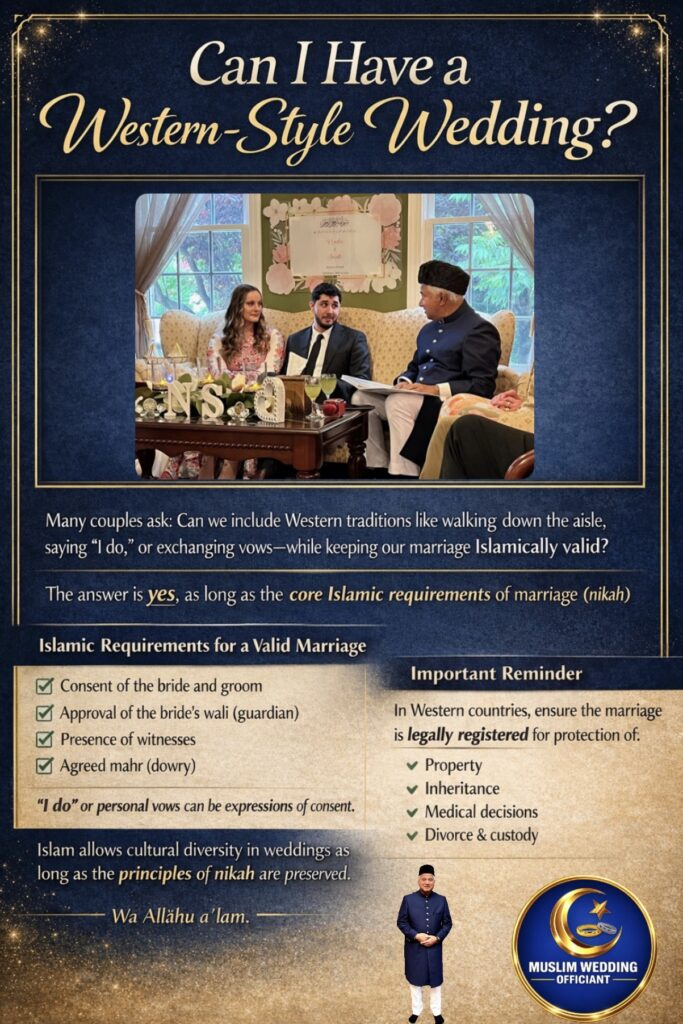
The short answer is yes—this can often be done in a respectful and balanced way, as long as the essential Islamic requirements of marriage are fulfilled.
Understanding the Islamic Foundations of Marriage
In Islam, marriage (nikah) is both a spiritual covenant and a social contract. While cultures may celebrate weddings differently, the core requirements for a valid Islamic marriage are fairly simple and widely agreed upon by scholars.
Generally, the following elements are necessary:
- Consent of both the bride and groom
- Approval of the bride’s wali (guardian)
- Ijab o Qabool – acceptance of each other as husband and wife
- Presence of witnesses
- An agreed-upon mahr (dowry) from the groom to the bride
- Aqd – Nikah contract
When these conditions are fulfilled, the marriage is considered Islamically valid.
The beauty of Islam is that it allows cultural expression, as long as it does not contradict these fundamental principles. In other words, Islam does not require weddings to look a certain way culturally; it simply requires that the core conditions of marriage are met.
Can Western Traditions Be Included?
Many couples today come from different cultural backgrounds, and it is natural for each partner to want some part of their traditions represented.
In my experience officiating many interfaith and intercultural weddings, couples often choose to structure their ceremonies in ways that honor both worlds.
For example, some couples choose to:
- Hold a separate nikah ceremony that fulfills the Islamic requirements
- Then have a Western-style ceremony or reception afterward
- Or combine elements of both traditions into one unified celebration
A couple may conduct the Islamic nikah first, ensuring that the marriage is religiously valid, and then celebrate with a Western-style ceremony later the same day or on another day.
As long as the Islamic conditions are met, cultural elements like walking down the aisle or exchanging personal vows are generally considered cultural expressions rather than religious obligations.
What About Saying “I Do” or Reading Vows?
This is another common concern.
The phrase “I do” is simply a verbal expression of consent. In Islamic marriage, the essential part is that the bride and groom clearly express their agreement to the marriage.
Traditionally, the marriage contract involves the offer and acceptance—sometimes called ijab and qabul. In essence, this is the same idea: both parties affirm their willingness to marry.
Therefore, saying “I do” in a ceremony is not inherently problematic if the Islamic requirements are also fulfilled properly.
Similarly, personal vows can be a meaningful addition to a ceremony. Many couples use vows as a way to express their intentions of kindness, respect, and partnership—values that are deeply aligned with Islamic teachings about marriage.
The key is to ensure that such elements remain respectful, sincere, and free of anything that contradicts Islamic ethics.
Why Legal Marriage Matters in Western Countries
Another very important point I often emphasize is the need for legal recognition of the marriage.
If you live in a Western country, it is strongly recommended—indeed, essential—that the marriage be recognized by the state. This means obtaining a legal marriage license and certificate in addition to performing the Islamic nikah.
This is particularly important for the protection of the bride, ensuring her legal rights in matters such as:
- Property
- Inheritance
- Medical decisions
- Divorce proceedings
- Child custody
- Will
Many Islamic centers and organizations require a legal marriage license before conducting the nikah ceremony for this reason.
For example, some Islamic organizations clearly state that couples must obtain a marriage license from their local city hall before the ceremony takes place.
This approach helps ensure that the marriage is recognized both religiously and legally.
It is also to ensure that both are free to marry each other, and there is no second marriage, which would be illegal.
Navigating Intercultural Marriages with Wisdom
When two people from different backgrounds come together, marriage becomes not just a union of two individuals, but often a meeting of two cultures and two families.
This can be a beautiful opportunity.
It allows both partners to:
- Learn from one another
- Honor each other’s traditions
- Build a new shared culture for their future family
What matters most is mutual respect and clear understanding.
If one partner is entering Islam, patience and compassion are especially important. Conversion is a profound spiritual journey, and incorporating familiar cultural elements can help make the transition feel welcoming rather than overwhelming.
A Balanced Approach
In many cases, the most harmonious solution is simply to separate the religious requirements from the cultural celebrations.
For example:
- Perform the nikah with the required Islamic elements.
- Complete the legal marriage registration required by the state.
- Celebrate with a culturally meaningful ceremony or reception that includes elements meaningful to both families.
This approach allows couples to honor their faith while celebrating their heritage.
Final Thoughts
Marriage in Islam is meant to bring tranquility, compassion, and partnership. The Qur’an describes spouses as garments for one another—providing comfort, protection, and dignity.
Cultural traditions can enrich a wedding, but they should always remain secondary to the values that make a marriage strong: faith, respect, sincerity, and commitment.
If the Islamic requirements are fulfilled and the ceremony remains respectful, incorporating certain Western traditions—such as walking down the aisle or exchanging vows—can be perfectly reasonable.
Ultimately, the goal is not to imitate one culture or another, but to build a marriage grounded in understanding, faith, and mutual care.
May your journey toward marriage be blessed with wisdom, harmony, and barakah.
Wa Allāhu aʿlam
Couple’s question is credited to Islamicity
Dr. Ghouse is the President and founder of the Center for Pluralism and director of the World Muslim Congress. He is an Interfaith Wedding Officiant for InterfaithMarriages.org and a Muslim Wedding Officiant. He is a Muslim, Pluralist, activist, speaker, author, and social scientist. More on Google – The author is a supporter of Muslims for Progressive Values.